
Managing multiple grants shouldn't mean drowning in spreadsheets every month-end. Yet for most nonprofits, that's exactly what happens when it's time to prove how staff time was actually spent across different funding sources.
Between federal grants with strict documentation requirements, foundation awards demanding detailed narratives, and corporate partnerships requiring quarterly reports, nonprofit finance teams face an administrative burden that basic time tracking tools simply can't handle.
The cost of getting it wrong is steep. When labor cost documentation falls short, organizations face:
- Disallowed costs that must be repaid
- Questioned costs that trigger additional audit scrutiny
- Findings that jeopardize future federal funding eligibility
- Damaged relationships with pass-through entities and funders
Research shows that nearly one in four organizations has faced audit failures related to labor cost documentation.
The challenge isn't just collecting hours, it's turning those hours into defensible, audit-ready labor cost data that satisfies every stakeholder from program officers to auditors to your own board.
This guide explains what grant management software is, why labor cost allocation matters for compliance, the features that actually support multi-grant reporting, and how to choose a grant management system that works for your staff, your finance team, and your auditors.
What is grant management software for nonprofits?
Grant management software helps organizations track restricted funding, allocate costs accurately across programs and grants, and maintain the documentation required for compliance and reporting.
Unlike project management tools that focus on deliverables and deadlines, grants management software addresses a fundamentally financial question: how do we prove that grant dollars were spent exactly as approved?
For nonprofits managing multiple funding sources, this question becomes exponentially more complex. Each grant program comes with its own allowable cost categories, allocation requirements, documentation standards, and reporting timelines.
The common thread running through all grant requirements? Labor costs. Staff time typically represents 60-80% of a nonprofit’s operating expenses, and it’s the most difficult cost to track accurately.
Effective funding management software not only helps organizations but also supports grantees by streamlining communication and providing resources to enhance funding outcomes.
The labor cost documentation gap most organizations face
Unlike rent or software subscriptions that map neatly to a single budget line item, staff time must be allocated across multiple dimensions.
When your development director spends Monday writing a grant application, Tuesday meeting with a major donor, Wednesday supervising the annual fund manager, and Thursday at an all-staff meeting, how do you categorize that time for reporting?
Federal regulations require this allocation to be based on actual work performed, not estimates or arbitrary percentages. The Office of Management and Budget's Uniform Guidance explicitly states that charges to grants must be based on records that accurately reflect the work performed, supported by a system of internal controls, and documented contemporaneously—meaning recorded when the work happens, not reconstructed weeks or months later.
Most organizations try to solve this challenge with:
- Basic time tracking tools that capture hours but don't categorize them for reporting
- Spreadsheets where staff estimate percentages of effort quarterly or annually
- Accounting software alone that records costs but relies on someone else to provide accurate allocation data, and timesheets are often incomplete or late
None of these approaches produces the contemporaneous, activity-based, verified records that federal grants require and auditors expect.
How grant management systems improve efficiency
A grant management system doesn't replace your nonprofit accounting software, whether that's Blackbaud Financial Edge, MIP Fund Accounting, NetSuite, or QuickBooks. Instead, it captures and categorizes labor data at the source when staff are actually logging their time.
The result: your finance teams stop spending days reconciling timesheets to grants, program managers get real-time visibility into grant burn, and auditors receive the contemporaneous, verified records they're looking for.
Good grant management helps smaller organizations and large nonprofits alike streamline operations, reduce administrative burden, and improve efficiency across the entire grants lifecycle—from application through closeout.
Why labor cost allocation matters for grant compliance
Proper labor documentation isn't optional for grant-funded organizations. It's a regulatory compliance requirement with real consequences when you get it wrong.
Federal compliance under the Uniform Guidance
Organizations receiving federal funding must comply with 2 CFR 200, which requires that charges to federal awards for salaries and wages must be:
- Based on records that accurately reflect the work performed
- Supported by a system of internal controls
- Incorporated into official records
- Reasonably reflective of total activity
- Compliant with established accounting policies
In plain language: you can't estimate staff time. You can't use arbitrary percentages that seemed reasonable when you wrote the grant proposal. You can't reconstruct time records retroactively when audit season arrives.
What private foundations expect beyond federal requirements
Private foundations and corporate funders are increasingly demanding similar standards. Many foundation program officers now require:
- Detailed budget-to-actual reporting showing staff effort by program
- Narrative explanations when actual spending deviates from proposals
- Assurance statements confirming funds were used only for approved purposes
- Final financial reports reconciling all grant-funded activities
When you can show actual time records organized by grant, verified by supervisors, and reconciled monthly, you demonstrate financial stewardship that builds relationships and trust for future funding opportunities.
Essential features that support multi-grant reporting
Not all management software can handle the complexity nonprofits face when juggling multiple grants with different requirements. Here's what grant management solutions need to deliver for compliance and program effectiveness.
Custom fields that capture grant categories at entry
Every time entry should automatically capture the dimensions you need for reporting:
- Grant or award number fields
- Program or service line categories
- Cost classification tags (direct vs. indirect, program vs. admin vs. fundraising)
- Activity type options that match specific funder requirements
When categorization happens at the point of entry rather than in spreadsheets weeks later, your data stays accurate and your finance teams spend less time on reconciliation.
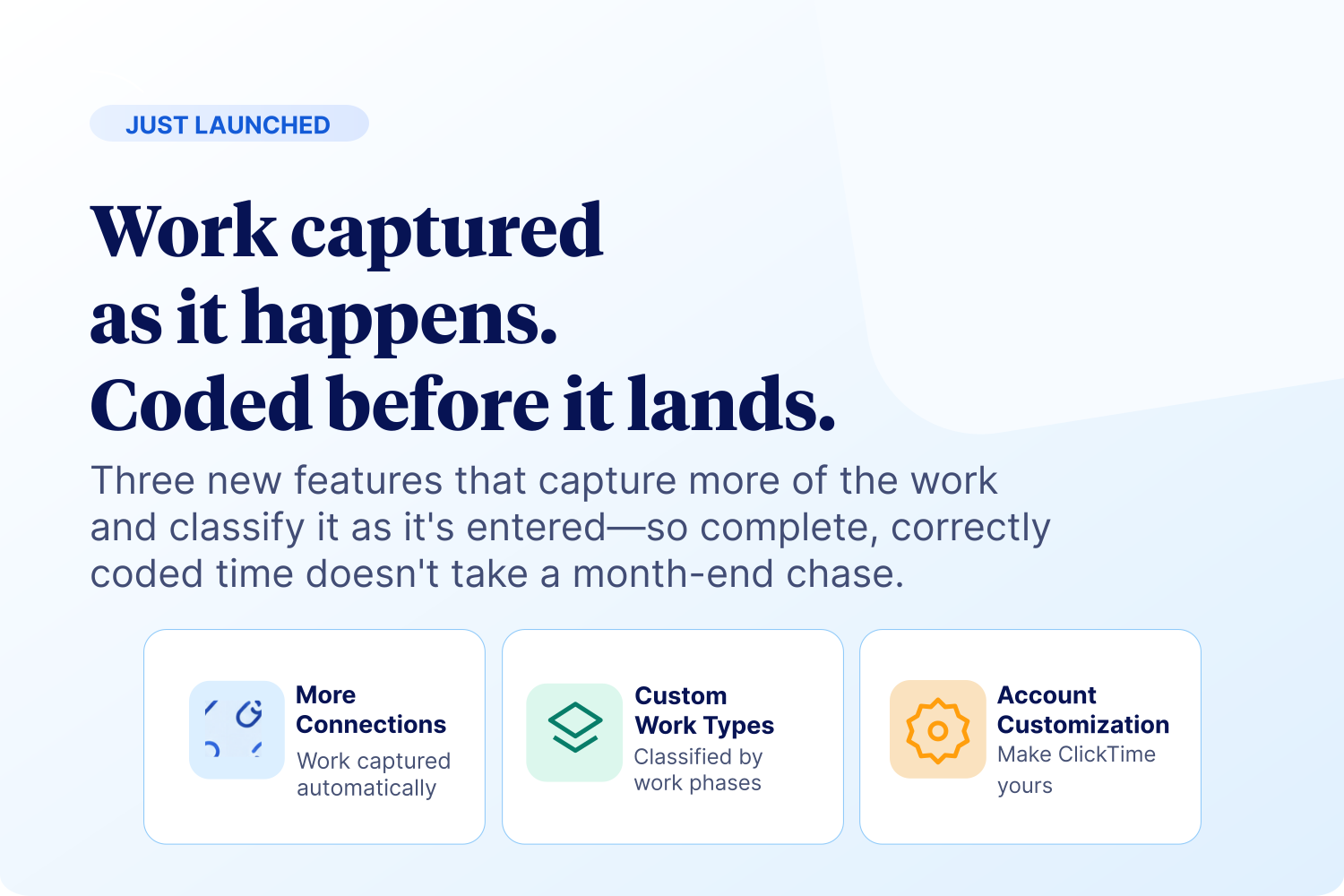
ClickTime's custom fields let you define exactly the grant codes, cost centers, and program categories your organization needs for compliance. Staff see only the options relevant to their role, and finance receives consistently categorized data without additional cleanup.
Flexible cost rates that reflect real expenses
Different grants often have different approved rates for the same staff member. The system should support:
- Person-specific rates based on actual salary and fringe benefits
- Role-based blended rates when grant budgets use standard position costs
- Grant-specific rate caps when funders limit reimbursement per hour
- Indirect cost rate application that automatically calculates overhead recovery
- Historical rate retention so past reports remain accurate
Approval workflows that create audit trails
Federal regulations and most foundation agreements require supervisor verification of time records. Grant management software should provide:
- Configurable approval hierarchies
- Required approval before charges post
- Complete edit history showing who changed what and when
- Timestamped submissions proving records were contemporaneous
- Rejection and correction workflows that maintain audit trail integrity
ClickTime's approval workflows route time entries to designated approvers before hours become final charges, and every submission, edit, and approval is timestamped and preserved.
Real-time visibility into grant burn rates
Discovering a grant overage during final closeout is too late. Effective grant management software provides full visibility when you can still make adjustments:
- Live dashboards showing grant burn by line item
- Configurable budget alerts at 75% and 90% spent
- Program-level rollups showing total spending across multiple funding sources
- Utilization reporting to see if staff allocations match proposed budgets
- Variance tracking comparing actual to budgeted labor costs
ClickTime provides real-time dashboards that show exactly where each grant stands against budget, so program managers can monitor their programs daily and track outcomes effectively.
Multi-dimensional reporting for different stakeholders
The system should support:
- Flexible report filtering by any combination of grant, program, employee, and date range
- Exportable formats in Excel, CSV, and PDF
- Saved report templates for recurring funder reports
- Permission controls ensuring appropriate visibility
ClickTime's Report Studio lets you build custom reports filtered by any dimension, then save those templates for one-click regeneration giving teams data-driven insights for better decision making.
Integration with your accounting system
Look for native integrations with nonprofit accounting platforms including:
- Blackbaud Financial Edge NXT
- MIP Fund Accounting
- Sage Intacct
- NetSuite for Nonprofits
- QuickBooks Nonprofit
ClickTime integrates with major nonprofit accounting systems, ensuring approved time data flows cleanly into your general ledger. This integration helps organizations improve efficiency and streamline the entire grants management process from entry through reporting, while our discounted nonprofit timesheet pricing provides significant value to nonprofits looking to better track and manage their resources.
Understanding the grant-making process and software
Grant management spans the full lifecycle, from planning and application through spending, reporting, and closeout. Each stage introduces operational and compliance challenges, especially when multiple funding sources are involved.
Grant management software helps organizations manage this complexity by centralizing data and reducing manual work.
Effective grant management software enables organizations to:
- Track budgets and expenditures across multiple grants in real time
- Maintain visibility into all active grants and funding sources
- Enforce grant-specific rules and compliance requirements
- Reduce administrative overhead through automated workflows
- Coordinate tasks, approvals, and communications across teams
- Keep reporting current and aligned with funder requirements
Beyond administration, grant software supports strategic decision-making.
With the right system, organizations can:
- Identify funding opportunities aligned to their mission
- Prepare consistent, compliant grant applications
- Monitor grant performance and spending against budget
- Track outcomes and demonstrate impact to funders and stakeholders
The result is less time spent managing processes and more confidence that funding is being used—and reported—accurately.
What audit-ready actually means in practice
Audit-ready labor documentation has six essential components:
Contemporaneous documentation: Time recorded when work is performed, with timestamps proving when records were created
Activity-based allocation: Actual work performed reflected in daily or weekly entries, not predetermined percentages
Supervisory review: Documented approval by someone with direct knowledge before charges post
Complete audit trails: Full history of every entry, edit, approval, and rejection with timestamps and user identification
Reasonable support for allocations: Specific activities or tasks captured, not just hours to generic categories
Alignment with policy: System configured to match and enforce your documented timekeeping policies
ClickTime delivers all six components of audit-ready labor documentation with timestamped entries, approval workflows, complete edit history, custom fields for grant codes and activities, and audit-ready reports.
Using labor data strategically beyond compliance
Once you have accurate, verified labor cost data, compliance becomes the floor rather than the ceiling. Data-driven insights help organizations maximize impact:
- Program effectiveness analysis: See which programs operate within budget and which consistently overspend
- Capacity planning for growth: Understand current utilization before committing to new multi-year grants
- Indirect rate optimization: Strengthen negotiations with documented allocation data
- Budget development: Base grant proposals on actual historical cost data
- Equity and workload management: Identify who's over-committed and who has capacity
These analytics support better planning, improve project outcomes, and help leadership make informed decisions about resource allocation and program initiatives.
Types of grant management solutions
Grant management solutions streamline complex processes from application to closeout. Organizations choose from three main types:
Cloud-based grant management software puts data and tools at your fingertips with automatic updates, instant collaboration for teams, and real-time tracking across all funding programs.
On-premise systems run on your servers, delivering greater control over data management and meeting strict security regulations for sensitive information.
Hybrid solutions combine both approaches—keeping sensitive data on-site while using cloud tools for scalability and access.
Effective grant management systems manage grant applications, track expenditures, ensure compliance, and provide full visibility into all awards. Automated processes reduce administrative burden while centralized data improves efficiency and communication across teams.
Best practices for grant seekers
Success requires more than submitting grant applications. You need a collaborative strategy focused on measurable outcomes:
Research and target the right funding opportunities: Find funders who match your mission and focus effort on the best opportunities
Build strong relationships: Talk with program officers regularly to learn what foundations and other funders really want
Leverage software and team tools: Use grant management solutions to track documents, manage workflows, and enable efficient collaboration
Prioritize data-driven decision making: Track applications, monitor progress, and measure program outcomes to demonstrate success
Track and report expenditures accurately: Record spending precisely and provide transparent reports on time to maintain stakeholder trust
These practices streamline your work, strengthen funder relationships, create better communication, and deliver results that win more grants and maximize community impact.
Why ClickTime works for grant-funded nonprofits
ClickTime turns work hours into finance-ready data that powers compliance across organizations of all types, featuring powerful reports for in-depth insight. For nonprofits managing multiple grants:
Labor costs are organized from the start because custom fields let you tag every hour with grant codes, program areas, and cost classifications.
Time records are verified before they become charges because approval workflows route entries to supervisors for review, with complete audit trails.
Real-time visibility prevents problems before they escalate with grant burn dashboards and budget alerts that support proactive management.
Reports satisfy every stakeholder because Report Studio lets you build Personnel Activity Reports, effort certifications, and funder-specific formats.
Integration with your accounting system ensures approved labor costs flow automatically to the right fund and program codes, helping finance teams close books faster.
Most nonprofits are running quickly with implementation in one to two weeks, including data migration, configuration, and training.
Final thoughts on grant compliance
Grant compliance isn't glamorous work, but it's the foundation that makes sustainable mission work possible. When you can't prove how grant dollars were spent, programs suffer.
The right grant management system transforms labor cost data from a documentation burden into strategic infrastructure that:
- Protects restricted funding from audit findings
- Gives program managers visibility to deliver on budget and track outcomes
- Demonstrates stewardship that strengthens funder relationships
- Enables informed, data-driven decisions about capacity and growth
- Ensures you recover full indirect costs under approved rate agreements
- Reduces administrative burden so staff can focus on program effectiveness
Your labor costs are already your largest expense. Treating them with the rigor they deserve—organized at entry, verified through approvals, visible in real time, audit-ready by design—isn't optional infrastructure for grant-funded nonprofits.
Ready to see how ClickTime works for grant-funded nonprofits? Book a demo to see audit-ready labor tracking in action, and see how we help organizations streamline grants management, improve efficiency, and maximize impact.