

In 2002, Avon improperly retained $26 million on its books from an abandoned internal-use software project that should have been written off. The SEC sanctioned the company, and PwC paid $5 million to the U.S. Treasury. (Source) Even though the work had genuinely been completed and the costs had been recorded, the lack of discipline to substantiate which labor still belonged on the balance sheet and which did not cost both dollars and reputational credit. More than two decades later, most organizations still struggle to enforce this same sort of discipline, and the conditions for that struggle are about to get harder.
AI is increasing outputs beyond what’s realistic to track manually
AI embedded in daily work increases employees’ pace, and likely their output too. Or from a pessimist’s point of view, it increases the output of the ones who will be sticking around once the dust settles. One thing that hasn’t changed is the set of standards governing how that work is reported.
The accounting department, and ultimately the controller, continue to uphold their responsibility to manage labor attribution. Whether that attribution flows into financial reporting under GAAP, tax filings under IRS rules, or invoices under a government contract, the underlying requirement is that labor must be tied to the work it supported. Hours remain the unit of record, even as each hour's work is more fragmented, more frenetic, and more opaque. New types of work bubble to the surface of nearly every salaried employee’s day: prompting, validating, iterating, and integrating outputs. The explosive rate of such change is magnified in departments of technical employees where workflows include coding, analysis, and documentation - some of AI’s most supercharge-able competencies.
Not only are technical departments riding the peak of the AI wave in terms of efficiency gains, but they are also an epicenter of capital investment. For many modern organizations with digital infrastructure for internal use or R&D work related to software innovation, CapEx budgets are increasingly consumed by the licenses and labor required to support these initiatives. While blossoming FinOps disciplines have largely whipped license cost management programs into shape, the labor cost associated with CapEx spend remains fuzzy for most organizations.
Compliant reporting still requires tracking work by hours
And at this moment in time, the powers that be (namely, the IRS, SEC, or your contracting body) regard not the channel through which capitalizable work was completed, whether AI, human, or both. No, the unit of measure for all external reporting remains the humble hour. For internal-use software, ASC 350-40 is explicit that capitalizable payroll costs are limited to employees directly associated with the project, to the extent of the time spent directly on the project. The human effort tied to qualifying work must still be measured to that extent, despite the increasing burden of doing so.
Our existing system of governance assumes a linear model for work. Each minute is linked to one discrete task at a time, and this time can be reported and tracked to the correct projects. But AI-driven work is non-linear, with agents working overtime and double time and everything in between to complete tasks on behalf of employees-turned-robot-managers. All time and effort reporting to this point has been an after-the-fact reconstruction of time, but this is quickly becoming an impossible task for even the employees themselves as their own work becomes obscured by small armies of bots. The risk that AI introduces from a reporting and compliance standpoint is a profound loss of traceability.
The false trade-off between productivity and accurate tracking
Financial leadership, from the controllership to the CFO, faces a chasm. Many assume a binary choice between compliance and productivity: allow their teams to fully leverage AI and thus lose control and traceability, or enforce tighter tracking but slow down productivity. This perceived trade-off is appearing implicitly in some more broad but frequently broached finance leadership concerns:
- Governance and accountability for AI-assisted work
- Confidence in outputs used for reporting or filings
- Unclear ownership of risk between finance, IT, security, etc.
The hesitancy brewing in the office of finance isn’t without reason. The consequences of the perceived trade-offs have significant ramifications. Misallocated CapEx could cost millions for some organizations, not to mention audit proceedings, or worse, findings. If work is capitalized but can't be substantiated because it took place buried within AI tools, the penalties could be severe. FASB's recent update, ASU 2025-06, has tightened the standard further: capitalization can't begin until significant development uncertainty has been resolved through coding and testing. AI-assisted workflows, by their nature, make it harder to identify the exact moment that threshold is crossed.
On the tax side, the stakes are higher still. Under IRC Section 174, software development costs must be treated as Specified Research or Experimental expenditures and amortized over five years for domestic work and fifteen for foreign. Allocating labor into those buckets requires the IRS's standard of a clear cause-and-effect relationship between costs and SRE activities. AI work that can't be traced back to a specific employee, project, and timeframe puts that allocation at risk.
AI-enabled tracking is crucial to keep pace with AI-enabled work
The good news is that the tension between more control and less productivity is a false one. As long as the unit of measurement for external compliance, not to mention internal cost analysis, is the hour, or even the minute, it’s the user’s own effort throughout a day that must be measured. To do so, AI must be wisely harnessed to keep pace with its own assistance of employee effort.
Artificial intelligence, however, cannot be left to its own devices when audit or sanction are in the balance. In the words of a Managing Director at Deloitte, "It's hard for an auditor to look at what AI produced and say that's an accurate reflection of the truth it's intended to portray. Because we can't audit the algorithms…So there needs to be, from an audit trail, some other validation point to authenticate that outcome.”
What’s needed is tooling that can match the speed and structure of the work by capturing activity closer to when it happens and using AI to reconstruct workflows in real time. To meet the stringent requirements of external governing bodies and internal classification schemas, the right tool must maintain human accountability for three areas:
- Attribution
- Review
- Accounting classification
The right solution to keep pace must passively capture employees’ effort throughout the day - without screen monitoring or invasive controls, of course - while maintaining the human thumbprint on the elements that make or break an audit. The key is to automate everything before and after that thumbprint to make capturing the hours feasible despite the pace of work. Redesigning how labor is captured without touching reporting structure will be the path forward for companies who can’t afford to fall behind on innovation nor to cut corners in tax credit claims or SEC filings.
Conclusion
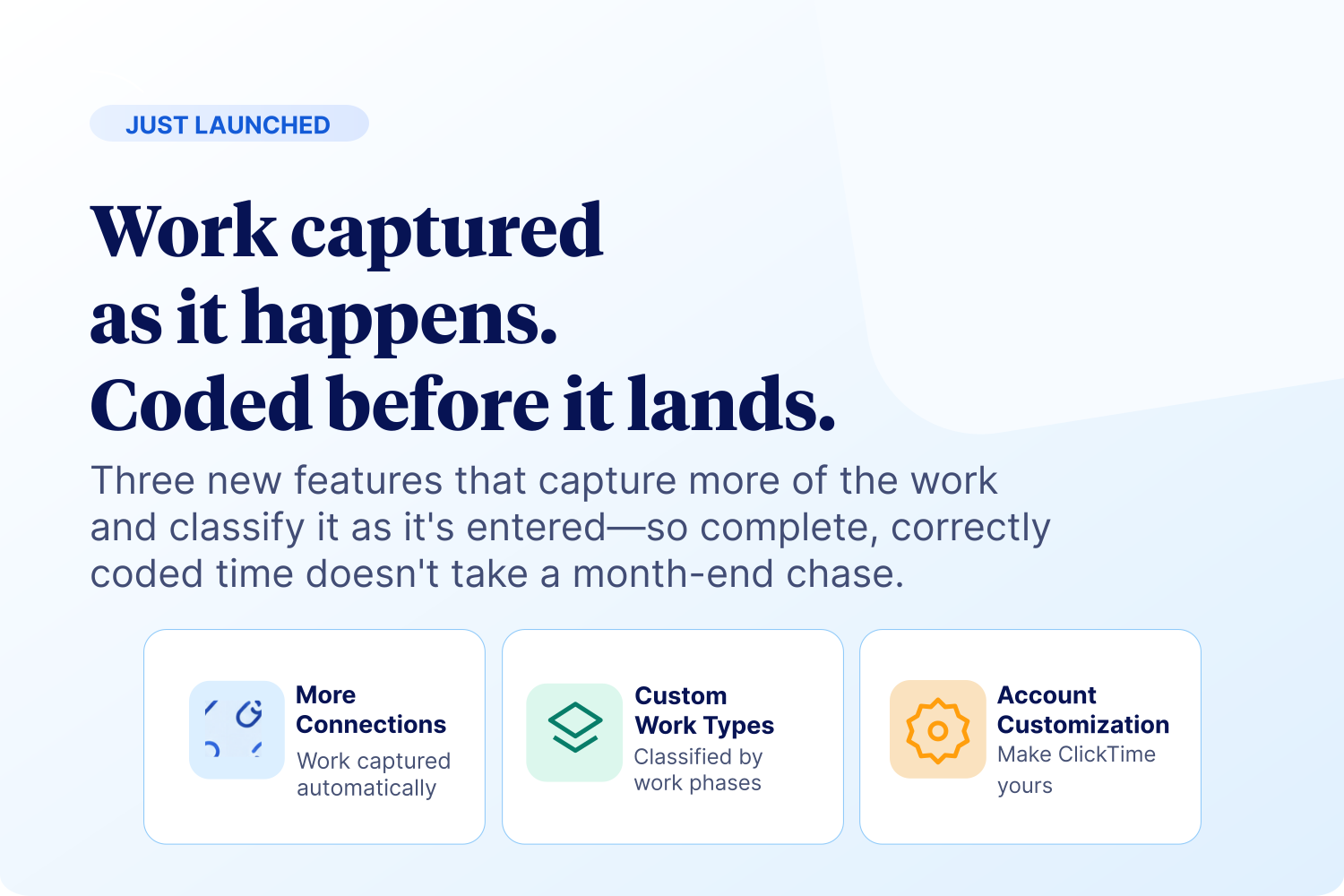
If you’re in financial leadership and working through these very challenges, we’ve just launched AI tracking to bring pre-categorized labor costs into your financial models without compromising auditability. We’d be happy to walk you through it.