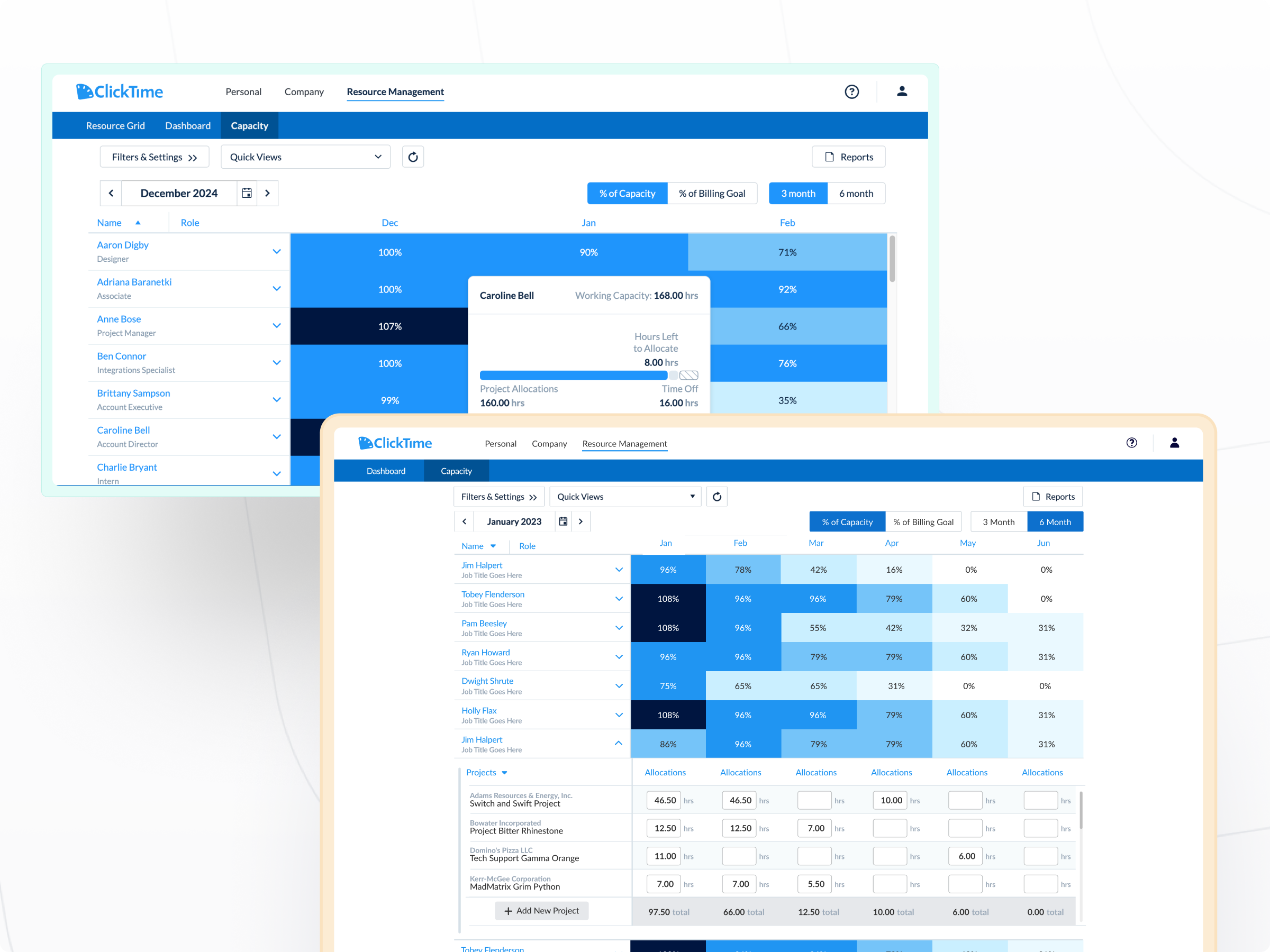
Move beyond Harvest: time tracking plus planning built for growing agencies

If you’re using a lightweight tracker and a separate planning tool, you already feel the cracks: no cost context, no future visibility, and no single source of truth. ClickTime unifies time, cost, and capacity—so you finally see profitability while work is happening.

Button
Button

When time tracking alone can’t keep up with the business.

ClickTime unifies time, cost, and capacity in real time so leaders can manage profitability while work is happening, not after the close.

20% revenue recovered

Teams using separate tracking and planning tools like Harvest + Forecast often miss billable work in the handoff. A unified, real-time system closes the loop so earned revenue doesn’t slip away.

Overruns caught early

Most platforms show you what already happened. Real-time visibility highlights budget risk as it emerges—so managers can act before margins are impacted.

"Lorem ipsum dolor sit amet, consectetur adipiscing elit. Suspendisse varius enim in eros elementum tristique. Duis cursus, mi quis viverra ornare, eros dolor interdum nulla, ut commodo diam libero vitae erat."
Name Surname
Position, Company name

Capture the revenue you’re already earning

If your team tracks time in one place and managers review budgets somewhere else, revenue leaks in the gap. ClickTime brings billing targets, approvals, and cost context into the same workflow—so nothing gets lost between systems

  • Billing targets visible on the timesheet, not buried in reports
  • Billable vs. non-billable tracked at the task level
  • Capture the revenue you’re already earning
  • Automated reminders close the loop

Catch over-servicing before it shows up on the P&L

Many platforms make it hard to connect detailed project activity with executive-level insight in real time. ClickTime brings both into the same view—so delivery sees burn while finance sees margin impact at the same moment.

  • Alerts before overruns become write-offs
  • Real-time burn vs. budget, not end-of-month reports
  • True cost rates, not just billable rates

Make client commitments you can actually keep

Planning without real cost and time-off context isn’t true capacity—it’s just scheduling. ClickTime shows availability with financial constraints built in, so forecasts reflect reality instead of best-case assumptions.

  • Capacity includes PTO and real utilization
  • Planned vs. actual side by side
  • Hiring forecasts tied to pipeline demand
Tagline

Built for teams that have outgrown basic time tracking

See how ClickTime compares to Harvest for teams that need real-time visibility into labor cost, capacity, and margins.

Header cell
ClickTime
Harvest
Billable utilization targets
Built into dashboards & timesheets
Retroactive only
Utilization visible to employees
Yes
No
Timesheets reflect allocations
Yes
No
Overtime tracking
Configurable
Workarounds
Planning granularity
Monthly, project, client, role
Weekly only
Blended cost rates
Yes
Limited
Capacity heatmap
Yes
No
Budgets visible during planning
Yes
No
Long-term profit analysis
Yes
Manual
FAQs

Common questions

Lorem ipsum diam quis enim lobortis scelerisque fermentum dui faucibus in ornare quam viverra orci sagittis eu volutpat odio facilisis.

Can ClickTime handle our billing model?

Yes—retainer, time and materials, fixed fee, hybrid. Set billing rates by person, project, task, or client. Apply blended or exception-based rates. Historical rates stay accurate even when you change them going forward, so past invoices and reports remain defensible.

We already have a time tracking tool. Why switch?

Most time tracking tools capture hours but don't categorize them in ways finance can use. If your current tool requires spreadsheet cleanup before you can invoice or report on profitability, you're doing work ClickTime eliminates. The question isn't whether you track time—it's whether that data is usable.

Can we track mileage in kilometers instead of miles?

Yes. Administrators can choose between miles and kilometers in Company Preferences. This setting applies organization-wide to ensure consistent measurement across all mileage entries.

What's the current IRS mileage rate?

Official IRS mileage rates are primarily published on the IRS Standard Mileage Rates page. The IRS typically announces these rates for the following year in December.

Stop losing visibility into your largest expense

Book a demo
Ask a question